
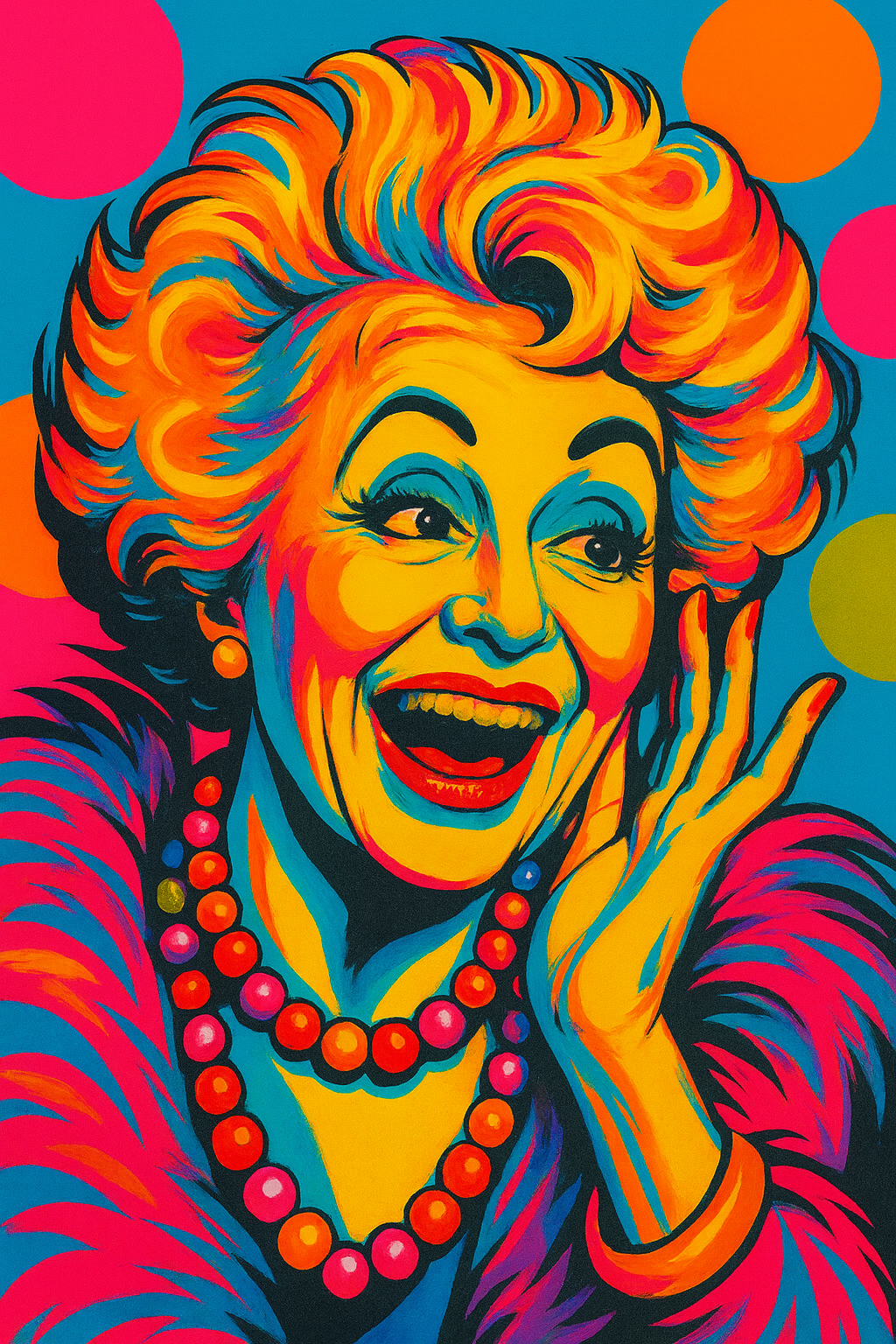
In an era where women were expected to be poised and polished, Phyllis Diller exploded
onto the stage with the unrelenting force of a hurricane. Armed with an unforgettable laugh,
Madam Diller was anything but demure. Her platinum blonde hair, an architectural marvel
all its own, was as much a part of her act as her sharp, self-deprecating humor.
Phyllis set fire to every mold of what an American woman was supposed to be. Her comedy
un-made the world’s expectations. She played with stereotypes of motherhood. She
mocked marriage. She broke beauty standards to pieces. And she annihilated them all with
a frenzied cackle.

Prelude in Chaos
In the beginning, well before the bravado, there was a woman who spent so many of her
early years battling her own insecurities. A car accident in her hometown of Lima, Ohio, at
age nine left scars on her face and on her psyche. The wounds would follow her into
adulthood.
In 1933, while Phyllis Diller was still in the cradle of her own ambitions, another infamous
figure was making headlines in Lima. John Dillinger, the notorious bank robber, had
escaped from Lima’s Allen County Jail. Dillinger’s gang, disguised as Indiana state troopers,
freed the gangster in a shootout straight out of a Hollywood film.
Dillinger disappeared into the dark Chicago underworld. Just a few short years later, at age
17, Phyllis set out for the same city. She enrolled at the Sherwood Music Conservatory,
intent on becoming a concert pianist.
Her parents feared that Phyllis’s adventurous spirit in Chicago would inevitably steer her
toward a dangerous future. They envisioned her life reminiscent of the tragic gangster molls
in noir films. But, after a close encounter with sexual assault in her small Chicago
apartment, young Phyllis returned home to Ohio and married.

The Spotlight Finds Her in California
By the early 1950s, her marriage to small town Sherwood Diller left much to be desired. She
found herself standing on the precipice of re-invention. San Francisco, a city brimming with
opportunity and the promise of radical transformation, became the perfect backdrop as
she followed her husband’s career shift westward.
A mother of six and now living on the West Coast, Phyllis scrambled through odd jobs to
keep her household afloat. Sherwood had buckled under the pressure of a reality away
from rural living. Phyllis, on the other hand, thrived. She immersed herself in the pulse of
Oakland’s advertising scene, first as head of newspaper and radio ad copy at Kahn’s
Department Store, then as a multi-faceted presence at KROW radio. There, as a copywriter,
publicist, and continuity girl, she honed the voice that would later crackle with irreverence
and audacity.

Comedy in Full Bloom
One night, while unimpressed with the quality of humor on television, Sherwood suggested
his breadwinning wife try her hand at the funny business. She never looked back. Phyllis
auditioned at the bohemian Purple Onion club in San Francisco. Maya Angelou was
performing at the time but left in 1955 after receiving an opportunity to tour with the opera
production of Porgy and Bess. Phyllis would replace her headlining spot. She stayed at the
Purple Onion for 89 straight weeks.
While at the Purple Onion, Phyllis became close friends with Alex Haley, who would later
write Roots. Then, Hollywood called. Catching fire, she was asked to appear on Groucho
Marx’s, You Bet Your Life. On January 30, 1958, she was broadcast from coast to coast into
every home in America.

Phyllis Diller Takes the Stage in New York City
It was 1959 when Phyllis Diller first appeared on The Jack Paar Show, marking the moment
her comedy reached a broader audience. The program, though not yet the Tonight Show we
recognize today, provided the national stage for her introduction into the mainstream. What
made her stand out from her peers, female comedians the likes Belle Barth and Jean
Carroll was her chaotic embrace of imperfection.
Barth flirted with the risqué. Carroll made biting observations about domestic life. Even
Rusty Warren cracked jokes about breasts. But Phyllis did the unthinkable. She turned her
flaws into punchlines. She mocked conventional beauty, even femininity itself. She lit the
world ablaze by simply poking fun at the things most women tried so feverishly to hide.

A Glimpse of Glamour in Splendor in the Grass
In 1961, Phyllis Diller made her film debut in Splendor in the Grass, Elia Kazan’s brooding
tale of young love and heartbreak. She played a nightclub emcee modeled after real-life
Prohibition-era personality Texas Guinan—brassy, boisterous, and impossible to ignore.
The role was brief, but Diller’s presence crackled on screen, offering a jolt of something
wild and unscripted in a film steeped in repression. The film, which focused on the
emotional turbulence of youth, was a huge success. The entire cast, which included a
young Warren Beatty, was applauded. Natalie Wood’s performance earned her an
Academy Award nomination that year. And, even Phyllis presented a foreshadowing of her
future in film.

Making Her Mark at the Bon Soir
The Bon Soir was a haunt for New York’s finest talent in the late 1950s and early ‘60s, and it
was here that Miss Diller carved her name into the comedy world. It was an intimate,
sophisticated venue in the heart of Greenwich Village, frequented by those with a penchant
for refinement. To the delight of a new crowd every night, Phyllis’s brand of humor was as
far from that standard as possible. She was wild, chaotic, and off the rails.
Arriving at the Bon Soir in 1959, she slowly built her East Coast following brick by brick. She
developed a kindred connection with a counter-culture, comedic jazz trio called The Three
Flames and merged her act with theirs for audiences who traveled around the country to
visit the Big Apple.
A tight-knit African American trio led by the charismatic pianist and vocalist Tiger Haynes,
The Three Flames blended jazz, pop, and rhythm and blues into something both polished
and playful. They were regulars on radio, beloved on the nightclub circuit, and even briefly
lit up early television with a show of their own in 1949.

A Collision of Comedic Flair and Vocal Majesty
In the early 1960s, a curious pairing took place at the Bon Soir. Phyllis Diller, the city’s
mistress of self-deprecation, would meet a young Barbra Streisand, whose vocal prowess
was still in its infancy. Streisand, who would obviously become a musical icon, performed
as the opening act for Phyllis at the Bon Soir in 1961. It was her first gig straight out of high
school.
Phyllis took an immediate interest in the teenage Streisand, sensing the young singer’s
immense potential. Their brief time together at the Bon Soir would mark the beginning of a
mutual respect that would later come full circle when Diller opened a televised tribute to
Streisand in 2001, reflecting on the profound recognition of two icons, whose careers had
taken distinctly different paths.

Turning Domestic Chaos into Comedic Gold
By the mid-1960s, Phyllis Diller had solidified her place in the cultural consciousness. But
she wasn’t content to rest on her laurels. In 1963, she released Phyllis Diller Tells All About
Fang, a tongue-in-cheek exploration of her “fictional” husband, Fang. Through her writing,
she turned the absurdities of marriage into comedy, finding humor in what many would
consider drudgery.
This was just the beginning. By 1966, her Phyllis Diller’s Housekeeping Hints became a
bestseller, turning the mundane struggles of a domestic life filled with burnt meals and
tangled laundry into the kind of comedic gold that would go on to define her career forever.

Satirical Takes on Motherhood, Aging, and Comedy’s Tough Road
Already an actress and comedienne, Phyllis continued adding to her career as a best
selling author. In 1969, The Complete Mother skewered the idea of motherhood as an
idyllic journey. Instead, she playful painted it as a chaotic, guilt-ridden roller coaster. It was
another hit.
A decade later, The Joys of Aging and How to Avoid Them offered a lighthearted approach to
growing older. Through her humor, she allowed her audience as an absurd, sometimes
hilarious reality. Her final book was her autobiography, Like a Lampshade in a Whorehouse.
The work recounts her chaotic climb through comedy’s back doors with the timing of a pro
and the scars of a woman who had to be twice as funny just to be heard.

Phyllis Diller’s Symphony of Comedy and Classical Music
Between 1971 and 1981, Phyllis finally chased her dream. Under the name “Dame Illya
Dillya,” she performed with over 100 symphony orchestras across the U.S. and Canada. Her
act, The Symphonic Phyllis Diller, was a dazzling blend of high art and slapstick comedy,
complete with pantomimes before moving into serious, classical renditions of Beethoven
and Bach.
The contrast was unexpected, yet delightful. Her act included humorous elements, like
entering the audience wearing an opera coat and gloves. And the world saw her true talent
when she performed a self-composed piece titled “Phyllis’s Fugue” alongside Liberace on
television. Together, the two titans demonstrated their talents for blending comedy and
classical music.

Final Curtain
Even after her peak and equipped with a pacemaker, Phyllis’s comedy never waned. She
worked steadily through the 1990s and beyond, leaving behind a legacy that would impact
generations of female comedians. The world she reshaped is much larger now, with
comediennes stepping boldly into arenas where they’d been previously shut out before.
And in that, Phyllis Diller wasn’t just the first lady of comedy, she was the architect of its
next era. And a hundred eras after.
Explore more of Phyllis Diller at dedicated Lima’s Funniest Lady page.

A Legacy in Performance, Film, and Written Word
Complete Discography:
- Wet Toe in a Hot Socket (1959)
- Phyllis Diller Laughs (1961)
- Are You Ready for Phyllis Diller? (1962)
- The Best of Phyllis Diller (1967)
- What’s Left of Phyllis Diller (1968)
- Born to Sing (1968)
- Live from San Francisco (2001)
- Phyllis Diller on Comedy (2009)

Selected Filmography:
- Splendor in the Grass (1961)
- The Fat Spy (1966)
- Boy, Did I Get a Wrong Number! (1966)
- Eight on the Lam (1967)
- Mad Monster Party? (1967)
- The Private Navy of Sgt. O’Farrell (1968)
- Did You Hear the One About the Traveling Saleslady? (1968)
- The Adding Machine (1969)
- The Sunshine Boys (1975)
- Pink Motel (1982)
- Happily Ever After (1989)
- The Nutcracker Prince (1990)
- Wisecracks (1991)
- Peoria, Babylon (1997)
- A Bug’s Life (1998)
- Everything’s Jake (2000)
- Goodnight, We Love You (2004)
- The Aristocrats (2005)
- Unbeatable Harold (2006)
- Forget About It (2006)
- Light of Olympia (2008)
- Looking for Lenny (2009)
- How to Live Forever (2009)
- I Am Comic (2010)
- When the World Breaks (2010)

Full Bibliography:
- Phyllis Diller Tells All About Fang (1963)
- Phyllis Diller’s Housekeeping Hints (1966)
- Phyllis Diller’s Marriage Manual (1967)
- The Complete Mother (1969)
- The Joys of Aging & How to Avoid Them (1981)
- Like a Lampshade in a Whorehouse: My Life in Comedy (2005)
